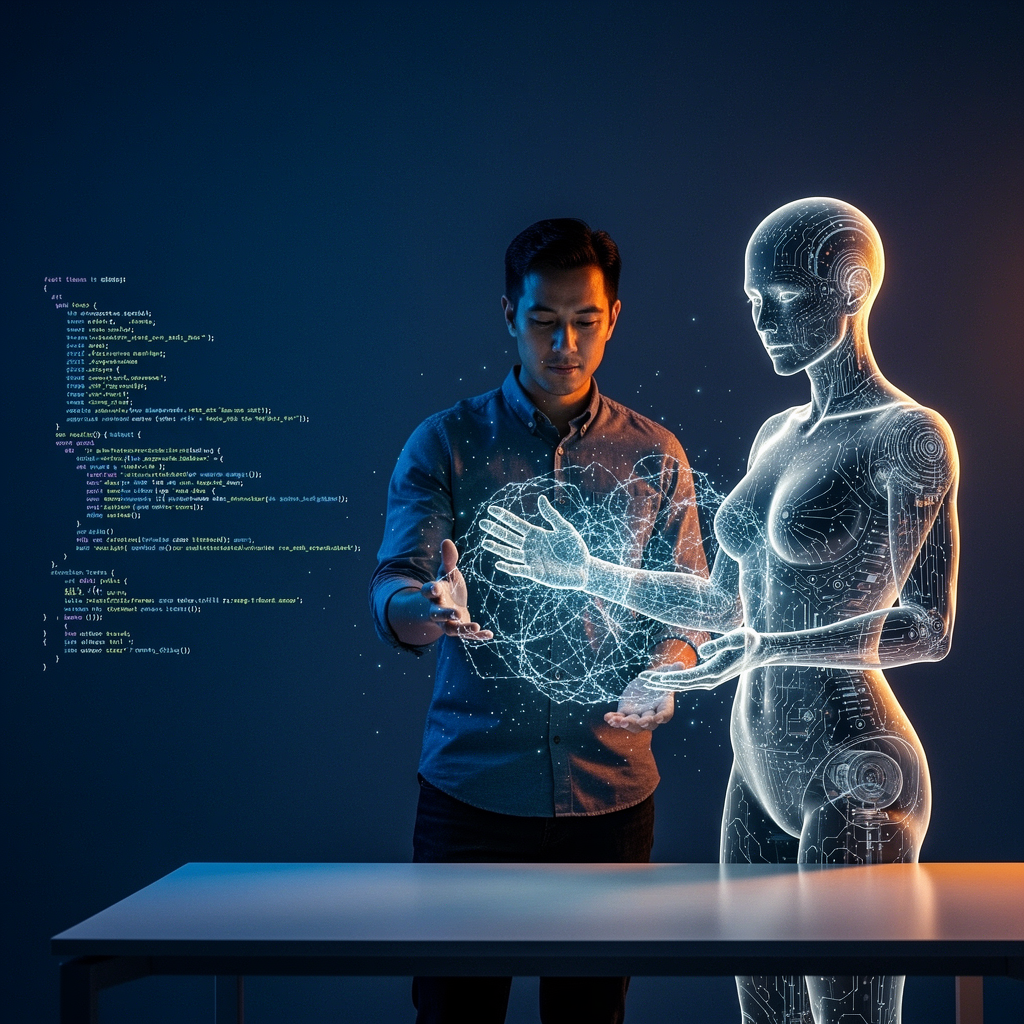
For decades, the craft of programming has been defined by a rigid, syntactic barrier: the wall between human thought and machine execution. A programmer might have a brilliant solution for a complex data architecture, but they are forced to spend hours translating that vision into specific, error-prone lines of code. This friction has historically capped our speed, our creativity, and our complexity. Now, that wall is becoming translucent. We are witnessing a fundamental move toward a collaborative state where human intent and machine execution merge into a shimmering, malleable light structure of functional logic. This shift, often mislabeled as mere automation, is actually a new horizon for digital creation.
Beyond Syntax: Sculpting the Digital Form
The traditional model of software engineering—the “write, compile, debug” cycle—is currently undergoing its most significant structural change since the introduction of high-level languages in the 1950s. Data from GitHub’s 2026 Developer Survey suggests that 84% of senior architects now spend less time writing boilerplate and more time defining system requirements and constraints. The machine is no longer a passive receptacle for instructions; it is an active partner in the design process.
Consider the recent implementation of neural-symbolic systems at firms like Anthropic and specialized boutique engineering shops. Instead of a developer manually mapping every edge case in a transaction pipeline, they describe the desired outcome and the environmental constraints. The AI avatar proposes the logic structure in real-time, visualizing the flow of data as a dynamic, glowing map. The programmer then nudges, refines, and shapes this structure. This is not about the AI doing the work; it is about the human moving from a manual typist to an architectural conductor. When the barrier of syntax disappears, the bottleneck of software production shifts from “how do I write this” to “what should I build.”
The Emergence of Fluid Architecture
When we strip away the cognitive overhead of syntax, we begin to see software as a form of liquid architecture. In traditional development, the structure of a codebase is solidified the moment it is committed to a repository. Refactoring is costly, risky, and slow. However, when an AI model maintains the state of the entire project, the codebase becomes a living, breathing entity.
We are seeing this in the rapid rise of “Context-Aware Development Environments.” Unlike the static IDEs of the past, these environments allow developers to ask, “If I change this API schema, what will be the downstream impact on user latency?” The system doesn’t just show a list of errors; it updates the digital light structure, highlighting the affected paths in real-time. According to a report by Forrester, teams adopting these fluid development environments report a 40% reduction in technical debt within the first six months. By turning code into a visual, navigable landscape, we allow human intuition—which excels at recognizing patterns and spotting structural weaknesses—to work in concert with machine speed.
The Human Necessity in Automated Systems
There is a prevalent anxiety that this collaboration will render the human programmer obsolete. This perspective misunderstands the nature of intent. While an AI can generate thousands of lines of syntactically correct code in seconds, it lacks the ability to understand the human values that underpin the product. Why is one latency trade-off acceptable for a banking app but not for a medical diagnostic tool? That is a judgment call rooted in human experience, ethics, and long-term business strategy.
The most successful teams today are those that treat their AI agents as an extension of their own cognitive process. At companies like NVIDIA, developers are using custom-trained models that reflect their specific internal design patterns, essentially cloning their best architectural practices. This creates a feedback loop: the machine learns the human’s aesthetic and rigorous standards, and the human gains a tireless assistant that handles the grunt work of maintenance. The result is a refined, more human-centric software product. We are not just building code faster; we are building better, more reliable digital systems that were previously too complex for any single human to hold in their mind simultaneously.
Navigating the New Horizon
As we stand on this new horizon, the measure of a great engineer is changing. Proficiency in a specific syntax is losing its premium, while the ability to synthesize requirements, understand complex system interactions, and guide a machine toward a sophisticated solution is becoming the new gold standard.
We must ask ourselves: if the labor of coding is effectively offloaded, what will we do with the saved time? Will we continue to churn out increasingly complex, bloated software, or will we use this freedom to focus on the harder, more impactful problems of interoperability, security, and true digital utility? The technology provides the structure, but we still hold the compass. The most profound innovation of this decade won’t be the AI itself, but the human programmers who recognize that the shimmering light structure they are building is simply the latest tool for expanding human creativity. When you no longer have to worry about the syntax, where will your vision take you next?