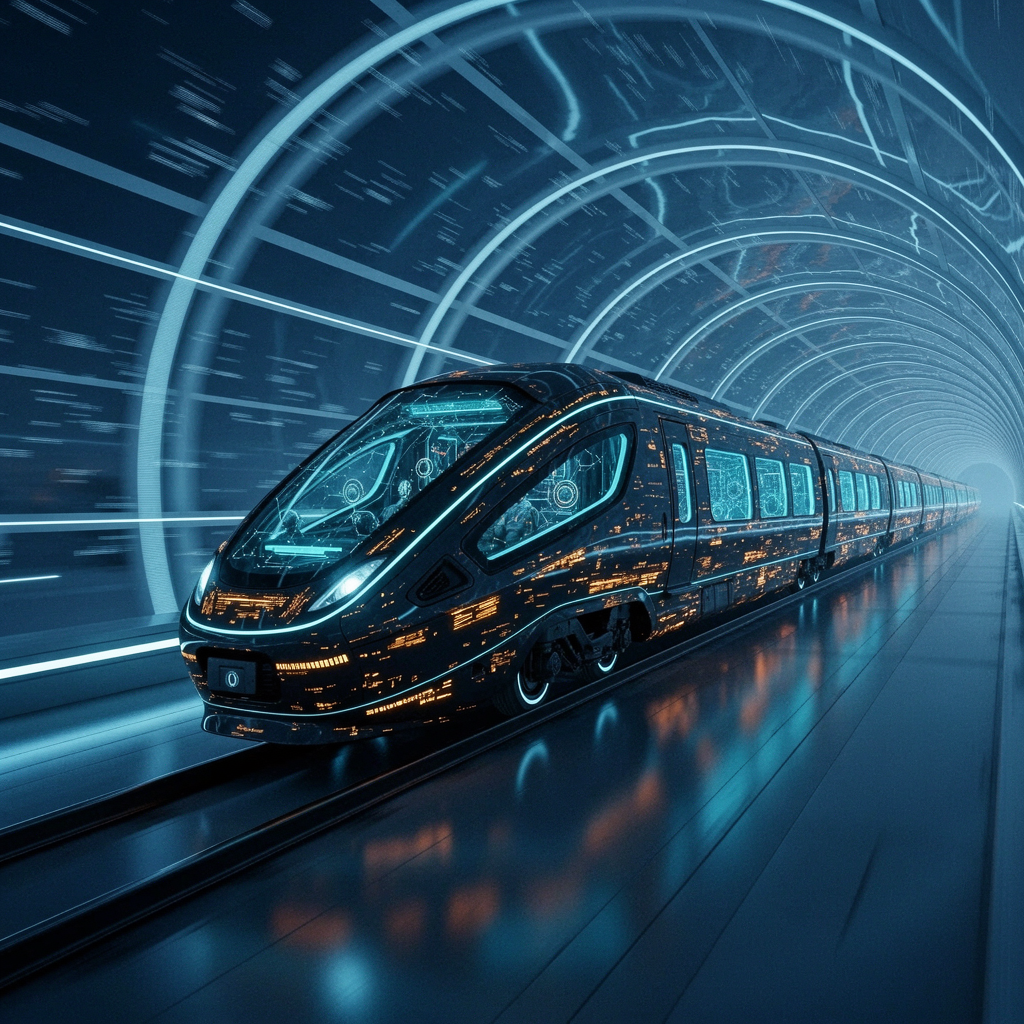
At 8:14 AM on a rainy Tuesday, the commuter rail line serving the northern corridor of a major metropolitan hub should have been paralyzed. A signal failure at the central junction usually guarantees ninety minutes of delays, overflowing platforms, and mounting frustration for thousands of trapped passengers. Instead, something unprecedented happened: the trains began to weave. Without human intervention, the fleet analyzed the emerging backlog and autonomously rerouted across underutilized maintenance tracks and bypass loops. Within six minutes, the entire system had stabilized, effectively “fluidizing” the transit bottleneck. This is the promise of the neural transit network, a system that replaces rigid timetables with living, breathing logistical intelligence.
Beyond the Static Schedule
For over a century, urban transit has been tethered to the tyranny of the timetable. We built systems on the assumption that demand is predictable—a legacy of an era before deep learning and ubiquitous sensors. However, static scheduling is inherently wasteful, forcing empty carriages to run at off-peak hours while leaving thousands stranded when spontaneous demand spikes occur.
Modern neural transit networks shatter this constraint by treating passenger flow as a dynamic fluid rather than a fixed cargo. By integrating real-time data from cellular pings, ride-share API feeds, and station turnstile sensors, these systems possess a high-fidelity map of where the city is moving at any given second. Research from the MIT Media Lab indicates that this type of “demand-responsive synchronization” can increase the effective capacity of existing rail infrastructure by nearly 40% without laying a single new meter of track. The train is no longer a scheduled entity; it is a reactive agent in a city-scale intelligence.
The Algorithmic Conductor
The primary challenge of a neural transit network is not the hardware, but the decision-making engine. Traditional signal control systems operate on localized, rule-based logic—if “A” happens, trigger “B.” In contrast, neural transit systems utilize reinforcement learning models that evaluate millions of potential route permutations every millisecond.
Consider the “Stuttgart Experiment,” where a pilot network implemented a decentralized AI control layer. The system didn’t just monitor delays; it proactively adjusted train speeds to prevent congestion from cascading downstream. When a delay hit one train, the AI instructed subsequent trains to dwell slightly longer at specific nodes, effectively absorbing the shock and preventing a platform-crushing bottleneck. The result was a 22% reduction in energy consumption and a marked increase in passenger satisfaction. By shifting from reactive management to proactive flow optimization, the network becomes self-healing.
Navigating the Human Element
Adopting a neural transit network requires more than just code; it demands a fundamental shift in how we conceive of urban governance. Critics often point to the “black box” nature of machine-driven decisions, fearing that AI could prioritize efficiency over accessibility, perhaps marginalizing lower-income neighborhoods in favor of high-traffic corridors.
Transparent algorithmic auditing is the only path forward. Infrastructure planners must ensure that the objective functions programmed into the neural transit network include equity metrics—such as maximum wait-time variance across different zip codes—not just total passenger throughput. In Singapore, the Land Transport Authority has begun requiring “explainable AI” protocols for all autonomous transit systems. This ensures that when a train deviates from its route, the logic is logged, transparent, and reviewable by human oversight committees. We are not abdicating control to the machine; we are merely moving human decision-making further up the stack, focusing on policy and ethics while the AI handles the complex geometry of urban physics.
The Future of the Fluid City
As urban populations continue to swell, the physical limits of our transit systems are fast approaching. Expanding tunnels and laying new tracks often takes decades and billions of dollars, making infrastructure growth a glacially slow process that rarely keeps pace with demand. Neural transit networks offer a bypass to this hardware trap. By squeezing more intelligence—and therefore more efficiency—out of the assets we already possess, cities can provide a premium experience at a fraction of the cost of traditional expansion.
We are moving toward an era where the concept of a “missed connection” becomes a relic of the twentieth century. In the near future, you will walk into a station not to consult a departure board, but simply to enter the flow. The train will be there when the city needs it to be there, sensing the pulse of the population and adjusting its path to meet the movement. The question is no longer whether we can build faster trains, but whether we can finally make our existing transit networks as intelligent as the cities they serve. When the infrastructure stops being a barrier and starts being a partner, what could your commute look like?