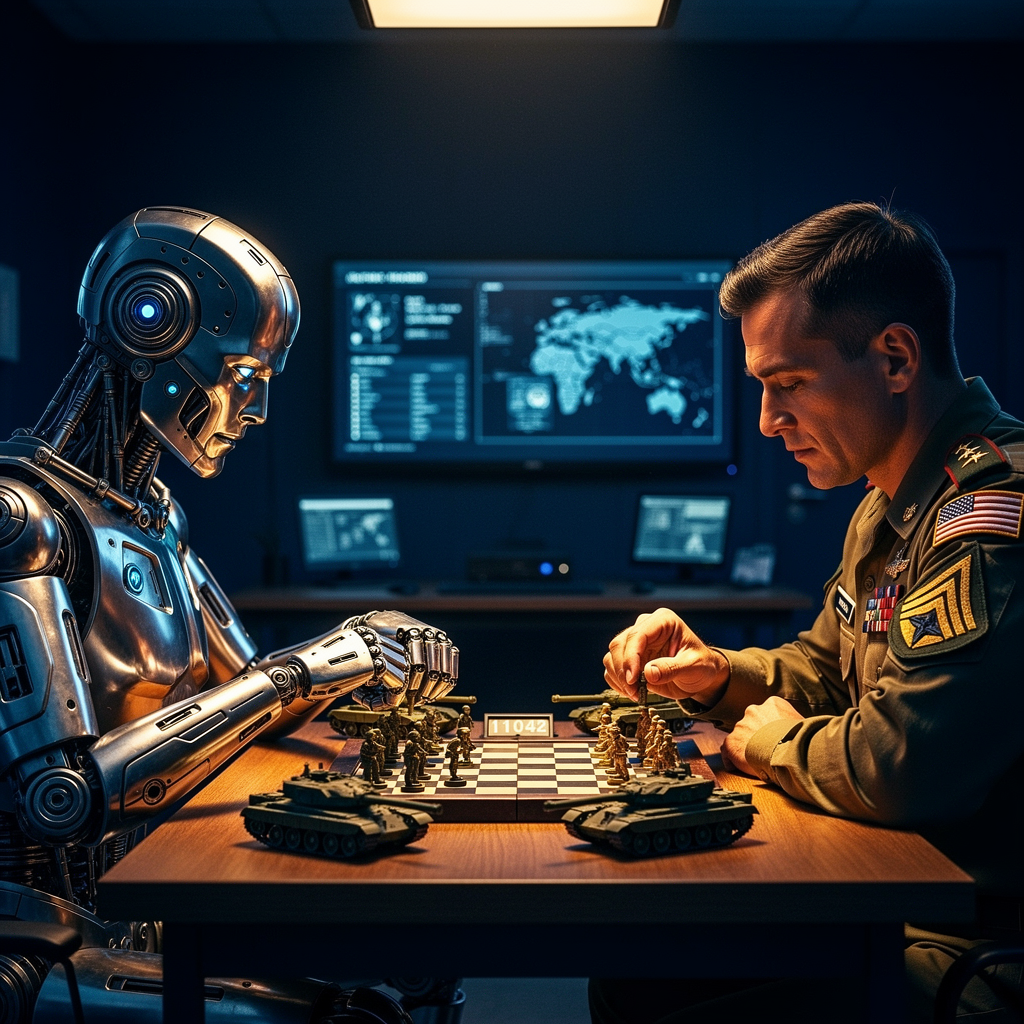
The hum of the cooling fan is the only sound in the command center. Opposite the human commander sits a chrome-plated, multi-articulated robotic chassis, its optical sensors locked onto the board. This is not a hobbyist setup in a Silicon Valley garage; it is a tactical simulation running at the Pentagon’s Defense Advanced Research Projects Agency. As the commander reaches for his knight, he isn’t just moving a piece of wood. He is testing his mental heuristics against a silicon battlefield where every potential future is mapped in milliseconds. The game serves as a stark reminder that while human intuition has defined warfare for millennia, the era of algorithmic supremacy is no longer coming—it has arrived.
The Death of the Intuitive Commander
For centuries, military victory depended on “the coup d’œil”—the commander’s ability to survey a chaotic field and instantly intuit the decisive move. History celebrated figures like Napoleon or Grant for this inexplicable sense of timing and terrain. However, the introduction of high-speed processing into the decision-making loop is stripping away the mystique of the veteran general.
In 2020, an AI agent developed by Heron Systems famously defeated a seasoned F-16 pilot in five consecutive simulated dogfights. The pilot, who had thousands of hours of flight experience, found himself systematically dismantled by a system that did not rely on “gut feeling.” Instead, the AI exploited the physical limitations of the aircraft and the human vestibular system, performing maneuvers that were mathematically optimal but intuitively counter-intuitive. This was not a failure of training; it was a fundamental incompatibility between biological processing speeds and machine logic. When the silicon battlefield demands decisions in microseconds, the human commander becomes a bottleneck rather than an asset.
Computational Strategy in the Age of Autonomy
The transition from human-led strategy to machine-augmented command is fundamentally changing how we define tactical risk. In traditional chess, players manage tension; in modern algorithmic warfare, they manage data entropy. The goal is to reach a state where the enemy is forced into a series of sub-optimal responses that compound over time.
Consider the recent implementation of the “AlphaGo” philosophy in drone swarm development. Researchers at the Naval Postgraduate School have found that when swarms operate using reinforcement learning, they develop defensive patterns that look erratic to human observers. By intentionally sacrificing peripheral units to gain a spatial advantage, these systems operate on a level of cold, computational pragmatism that rarely occurs to a human officer bound by the psychological weight of resource preservation. We are moving toward a reality where the commander’s role is reduced to setting the objective function—“win the engagement at minimum cost”—while the machine determines the chaotic, non-linear path to get there.
The Vulnerability of the Black Box
Despite the tactical superiority of machine logic, the reliance on such systems introduces a fragility that history has not yet accounted for. The silicon battlefield is governed by data, and where there is data, there is the potential for adversarial interference. The same mathematical rigor that makes an AI a formidable strategist also makes it susceptible to “adversarial examples”—tiny, calculated perturbations in the input data that can cause an entire system to hallucinate a threat where there is none.
An autonomous system might identify a civilian truck as a main battle tank simply because the image was subtly altered with specific pixel noise. This is the new tactical reality: the commander must now play a meta-game, not just against the enemy’s hardware, but against the hidden biases and blind spots embedded within their own algorithms. As we lean harder into machine-led command, we risk creating a military structure that is brilliant in its execution but catastrophically brittle when faced with an unpredictable or malicious input.
Beyond the Board
The image of the chrome soldier playing chess is a mirror reflecting our own aspirations and anxieties. We seek to remove human error from the battlefield, yet in doing so, we might be removing the very capacity for ethical judgment that is required when the rules of the game change mid-encounter. An algorithm can win a game of chess, but it cannot decide that the game itself is no longer worth playing.
As we continue to integrate these systems into our command structures, we must ask if we are merely optimizing our tactics or if we are inadvertently surrendering our agency to the cold, unfeeling logic of silicon. The most significant challenge in the next decade of defense will not be building a faster processor or a more lethal autonomous unit. It will be determining how a human commander can remain the master of a silicon battlefield, rather than becoming its most predictable pawn. Can we preserve the essence of human strategic judgment in an age where the machine sees further, thinks faster, and acts without hesitation?